Let’s skip the stories and get straight to the hardware. If you’re trying to figure out the difference between sublimation and heat transfer printing, the real answers are sitting right there on your equipment shelf. The machines, the inks, the papers—they’re completely different. Here’s what you’re actually working with.
The Printers: Two Different Beasts
Heat transfer vinyl doesn’t need a special printer at all. You’re using a vinyl cutter—a machine like a Cricut, Silhouette, or larger commercial plotter that physically cuts through colored vinyl sheets . The machine has a blade that moves back and forth, carving your design out of rolls of pre-made material. Think of it like a precise pair of scissors controlled by a computer. No ink involved. Just cutting.
Sublimation requires an actual inkjet printer, but not just any inkjet. You need a printer specifically designed or converted for sublimation inks . Most people use Epson printers with piezo printhead technology because they handle the special ink without clogging . The printer looks normal and works normal—until you look inside and see the ink cartridges are completely different.
The Inks: Chemistry You Can See
This is where things get interesting.
Heat transfer vinyl uses no ink at all. The color is already in the vinyl sheet. Manufacturers mix pigments into the vinyl material during production, so when you buy a roll of red HTV, that red is throughout the entire thickness of the material . You’re essentially buying colored plastic film with heat-activated glue on the back.
Sublimation uses dye-based inks that are anything but normal. These inks are designed to turn into gas when heated—literally skip the liquid phase and become vapor . They’re translucent, which is why they don’t show up well on dark fabrics. And they only bond with polyester at a molecular level . The chemistry is specifically engineered for that gas-to-solid transformation.
The Carrier: Paper vs Film
Heat transfer vinyl comes on a clear carrier sheet. That’s the plastic layer on top that holds everything together while you cut and weed . You cut through the colored vinyl but leave the carrier intact, then peel away the excess vinyl (weeding), and the carrier helps you position the design before pressing. After heat application, you peel that carrier off, leaving just the vinyl on the garment.
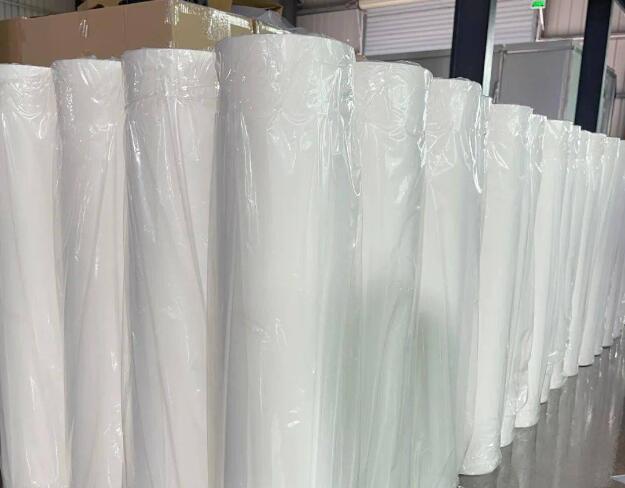
Sublimation uses special transfer paper . It looks like regular paper but has a coating designed to hold the sublimation inks and release them perfectly when heated. You print your design onto this paper (in mirror image), let it dry, then place it on your substrate. The paper itself doesn’t become part of the final product—it’s just the delivery system. Quality sublimation paper has specific coatings and weights (like 75gsm, 95gsm, 100gsm) that affect how much ink it holds and how well it releases .
The Heat Press: Same Tool, Different Rules
Here’s the twist: both methods use a heat press . The machine itself can be identical. But what happens inside that press is completely different.
For heat transfer vinyl, the heat activates the adhesive layer on the back of the vinyl . It melts the glue, bonding the vinyl to the fabric fibers. The vinyl itself stays solid throughout—it doesn’t change form, it just gets stuck on.
For sublimation, the heat turns the solid ink into gas . That gas then penetrates the polyester fibers and, as it cools, returns to solid form inside the material, not on top of it. The paper you used is now empty—all the ink migrated out.
The Blanks: What You Print On
Heat transfer vinyl works on anything that can handle heat and pressure. Cotton, polyester, blends, leather, wood, hats, bags—if it fits in the press and doesn’t melt, HTV will stick to it . The vinyl itself provides the color, so the base material color doesn’t matter. Black shirt? White vinyl shows up perfectly.
Sublimation only works on polyester or polymer-coated surfaces . The ink needs polyester to bond with chemically. And the base needs to be white or light-colored because the inks are translucent . Dark shirts? Forget it—the design will disappear. This is the biggest practical limitation of sublimation.
The Support Equipment
Heat transfer vinyl needs:
A vinyl cutter (plotter)
Weeding tools to remove excess vinyl
A heat press (or iron for small projects)
Optional: transfer tape for some applications
Sublimation needs:
A sublimation printer with special inks
Sublimation paper
Heat-resistant tape to hold paper in place
A heat press (temperature must be precise)
Butcher paper or Teflon sheets to protect your press
Lint roller for pre-cleaning blanks
The Cost Breakdown
Heat transfer vinyl has lower startup costs. Entry-level vinyl cutters run $200-$300 for hobby models. The vinyl itself costs anywhere from $5-$20 per roll depending on type and brand. You can even start with just an iron before investing in a heat press .
Sublimation requires more investment. A dedicated sublimation printer starts around $300-$500 for converted models. Sublimation paper runs $1-$2 per sheet for small quantities . Inks are more expensive than standard printer ink. And you absolutely need a quality heat press with consistent temperature—cheap ones ruin projects .
The Bottom Line
Sublimation is about chemistry and transformation. The equipment exists to turn solids into gases and bond them with polyester. The magic happens inside the material.
Heat transfer vinyl is about cutting and sticking. The equipment shapes pre-colored material and glues it on top. The magic happens in the weeding and placement.
Neither is better. They’re just different tools for different jobs. Now you know what’s actually inside the machines.